by Gilbert (Punky) Mudge with Wiebe Dragstra and Ann DeKeyser
Introduction
By way of introduction, I am a frustrated farmer who started to ride when my wife was pregnant for the third time and her horse needed exercise.
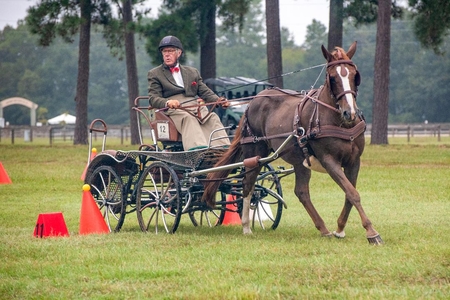 Punky and Emma competing in the cones phase at the Timberland CDE in 2023 (Photo by Diane McKay)I learned how to jump by following a hunt - that was easy - and we then shifted our equestrian interests to eventing.
I could handle Training and Preliminary courses until I had a horse who refused every ditch.
Although it was difficult for me to prevent the horse from jumping out of the ring, I endured dressage to get to the fun part.
My family eventually assigned me horses that were intermittently lame, so my competitive career was over, over until I volunteered at a Combined Driving Event.
What a potential blastl
I found a wonderful driving mare on 'dreamhorse.com' and a carriage.
I convinced a skeptical family that at the age of 74, I could be safe while having fun and that slmthetic tack did not need the same assiduous attention as leather.
I found instruction in the basics and then shifted gears during the pandemic to a more structured instructional program.
FOUR YEARS later, driving is now part of my daily routine.
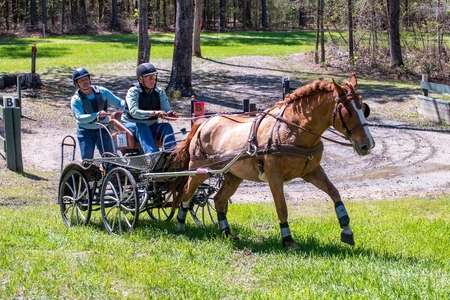 The marathon: "an extension of dressage and cones (Photo by Diane McKay)These notes reflect that journey.
I organize these thoughts out of concern that the CDE equestrian discipline is a dying discipline.
Large competitions are difficult to sustain with very limited competitors at the higher levels.
Each year, important competitions are tenuous or canceled because of a lack of entries.
Two competitive governing bodies seem more preoccupied with their politics than a troubled future.
The necessary logistics of the discipline, which include carriages, tack, trailers for carriages, and navigators, in addition to horses, limit the general appeal and growth for younger equine enthusiasts.
European drivers put US efforts to shame in numbers as well as expertise; we should be doing better.
These notes are only germane to single horses or ponies trained to drive; multiple animals are beyond my expertise and my bank account.
Dressage
Simply put, dressage training is the key to all three phases of a CDE.
How balanced is the horse, and how does it move through the transitions? That's it.
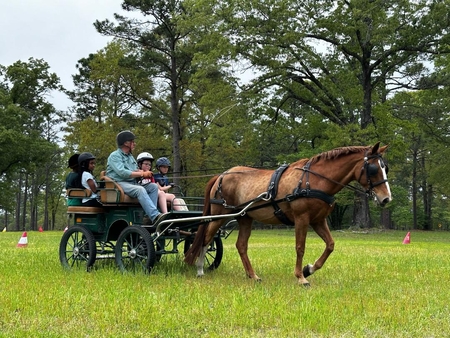 Gilbert (Punky) Mudge, MD, is a cardiologist, medicine professor, and emeritus at Harvard Medical School.As opposed to eventing, we do not need to worry about complex striding, the boldness of the animal, body position, complex related distances to jumps, etc.
The few aides that we have - reins, voice, whip, body position in the carriage, and carriage brakes - achieve the gaits.
That brings us to the half-halt.
It has taken me years to learn an effective halfhalt.
The FEI defines the half-halt as a combination of driving aids with leg and seat and restraining aids in reins to bring the horse's weight more under the hind legs and off the front legs.
The animal is now "on the bit."
It is both restraint and drive that achieves balance.
But the FEI seems to have forgotten that drivers do not have a seat or legs to help.
The driver achieves this with voice or whip and hand communication.
My use of the whip on the horse has proven to be woefully ineffective.
I have no interest in smashing the horse to scare or intimidate; the mare is a wonderfully cooperative animal.
To effectively tap her forward, I would need to reach to the right front shoulders, and such a reach moves my right hand forward, vith resultant imbalance and loss of contact with the reins; the left shoulder seems impossible.
Perhaps a longer whip would do the job, but alternatively, I have trained my mare to my whistle.
By cracking the whip five feet to her side but never hitting her and giving a simultaneous sharp whistle, she has learned to drive forward.
I now just whistle and get the forward response.
The restraint is achieved by an active outside rein.
The outside fingers rhlthmically squeezes per second, the inside rein steady.
At the beginning of each ride, I may have five pounds to pull in each rein, but with warm-up, it becomes a comfortable one-two pounds.
This constant hand communication is essential as the horse knows it is still being driven, back and forth with the hand motions as the outside
rein changes; an electric outside rein is what you want to achieve.
I practice it with hacks; muscle memory for this type of communication becomes essential in any phase of competition.
Right, left, right, left, right, left.
Through cones and obstacles, one is constantly changing the outside rein, thus achieving balance.
Gaits
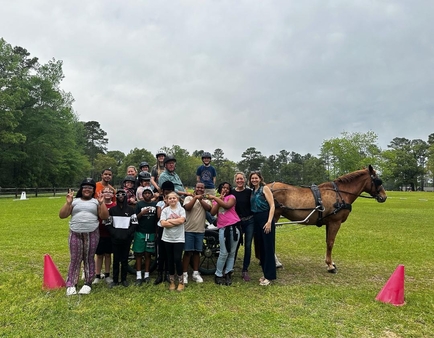 Punky and Emma introduce driving to young horse enthusiasts from Weymouth Equestrian and The Boys and Girls Club of the Sandhills.
(Photo by Doni Boudreau)The halt, walk, working trot, collected trot, medium trot, extension, canter, flying changes, and reinback can all be achieved by voice command and a whistle.
The whip can be additional communication, but the voice command becomes central.
Cross-Traininpl
The most effective way to begin to train a driving horse in dressage is by cross-training it under saddle.
I assume the animal is large enough to ride and broke to the saddle, and that one can find a dressage queen friend to help.
With a little practice., voice commands are instilled in conjunction with the legs and the seat.
The rein back can be achieved without losing the balance of the horse.
Halts can be squared more readily, and transition to canter and then switching leads with flying changes far more facilitated when done in conjunction with voice command and legs.
Make sure voice is part of the cross-training.
A silent DQ is of little help.
The Competition
You are your only competitor.
The simple objective of a CDE competition is to be better than the last one.
Forget the rayon.
If you really need to decorate your tack room, contact hodgesbadges.com; you can have a beautiful tack room for the cost of a few gallons of gas.
I get a little frustrated when one organizer wants to extend a CDE competition to four days to have a ribbon ceremony after cones; I am ready to get home.
Levels of Competition
I was once advised that at my age, I should stick to the Training level.
However, the challenging dressage tests and obstacles are at the Intermediate level.
Training my horse to get the correct canter lead was a great satisfaction, leading to flying changes, which is a blast.
As far as obstacles are concerned, figuring out and remembering the five gates to an Intermediate marathon obstacle is often better mental stimulation than Sudoku.
And who really cares about the time?
You can learn from fellow competitors.
I usually wait to watch two or three groups walk an obstacle before deciding on my path.
The Judges
I have read that the judges are the most important part of a competition.
I'm afraid I have to disagree.
Without the energy and resources of an organizer, there is nothing.
Without volunteers, there is nothing; without competitors, there is nothing.
Judges should be considered teachers; they need to judge dressage and not breeds.
A great judge can really help by using the scale and providing meaningful comments; a poor judge gives all 5.0s with no comment.
It's hardly worth the time.
Judging has two components: subjective and objective.
The subjective component will vary from judge to judge and includes all the directives of the test, engagement, suppleness, bending, impulsion,
submission, presentation, etc.
You cannot ahvays prepare for this; you got what you got.
The objective components should be easier to correct and improve.
Is the line from A to C straight? Are circles symmetric? Have you stopped at X? Did you make mistakes in the test? Are there the correct number of steps in the rein back?
Are you showing enough transition from gait to gait, for example, collected to working trot?
Any test can be dissected to the objective components.
And if you miss on these, you are simply beating yourself.
Dressage
There is little to add to the dressage test ifyou have achieved your half-halts and knowthe objective pitfalls of eachtest.
This phase is the best one to compete against yourself.
And advancing from Training to Preliminary and then Intermediate is a laudable goal.
The greatest problem that I encountered was improving the halt.
When we started, the mare would fall back to three Iegs at the halt as if she were smoking a cigarette,
Ten thousand halts later, we are bette rbut not great.
Cones
I have never met a cone that cannot be fully rejuvenated after it has been smashed.
So, cones practice is a great place to practice half-halts and balance, turns and speed.
Robin Groves from Vermont gave me great advice when I began - aim for the outside cone.
I now know why.
There will be a turning arc for each cone, to the right or left after the cone, rarely just straight on.
With the horse balanced and now in the outside rein, focusing on the outside cone will give one the greatest turning radius for the inside wheel.
The inside wheels cause the most grief.
Pick up the pace.
With correct balance, it becomes a blast.
And great training for obstacles.
Marathon
Now, the fun.
An equestrian competition against the clock.
Marathon becomes an extension of dressage and cones.
Phase A tests your conditioning and sense of speed.
Can you make the kilometer marks while saving the horse/pony for Section B?
This is an important traditional component of the discipline.
The 'controlled warm-up' we now face is an insult to conditioning efforts and dumbs down the best traditions of the sport; it should only be used
when absolutely mandatory.
Obstacle speed is the winner, and I am resigned to being the loser.
Expertise reflects experience and an obstacle course is difficult to find for practice.
But if one has the balanced horse achieved with half-halts, maintains the outside arc, keeps looking up to the next gate or access lane synchron ywith your navigator, and changes gaits without losing balance, what a blast!
Stand in the middle of an obstacle and look at all the escape routes.
Watch a video of the European Championships.
Look at the flying changes and balance of the real experts.
That becomes a long-term goal.
But it all starts with dressage.
Conclusion
As I turn 80, I need to improve my collected trot, extensions, and halt.
I hope I can interest my grandchildren and children from the community in driving.
I am less optimistic about the future of the discipline.
Too many competitions are canceled, undersubscribed, or threatened, and there is little national leadership that recognizes the problem and addresses it; egos get in the way.
CDEs are being dumbed down as is happening in other equestrian disciplines.
Instead, we should aspire to growing a tradition while adapting it to a changing time.
I said Iwas a nerd.
Gilbert (Punky) Mudge MD is a Cardiologist and Professor of Medicine, Emeritus, Harvard Medical School.
This article was previously printed in Driving Digest