By BETSY DeMARINO
Fifty odd years ago, I was working hard, trying to get into veterinary school, polishing up my resume and trying to get the best work qualifications I could.
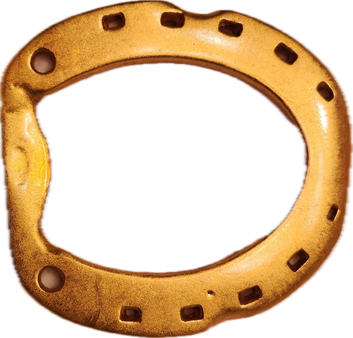 Bally Cor's gilded hoofI had the great good fortune to know Dr. Charles Reid, Chief of Large Animal Radiology at New Bolton Center, as a mentor, friend, neighbor and fox hunting buddy.
We sometimes rode together as a pair or team for hunter trials and paperchases.
Charlie offered me a job as a junior radiology technician at New Bolton Center, which was hugely significant for my ambition.
Charlie had done some favors for the owner of Cormac, the champion steeplechase horse of his time.
He offered a free breeding to Cormac for Charlie’s mare, Ballylickie, and so Bally Cor was born.
Bally Cor, like her mom, was somewhat opinionated.
I heard this from friends of mine who had been short listed as Olympic three-day riders and had gone to Gladstone, N.J, for tryouts.
Apparently, several Olympic hopefuls who tried Bally Cor did not get on well with her.
That was until Tad Coffin, at 21, one of the youngest Olympic hopefuls, was assigned to the opinionated mare.
That paring clicked for Bally Cor and she became devoted to Tad as her chosen rider.
NOW HERE is the part of the story that most people never knew.
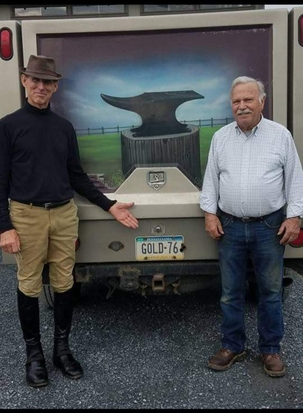 Tad Coffin, left, and Kearney Hillard, the unsung hero of the 1976 Olympics, in front of Hillard's truck Bally Cor was born with OCD (osteochondrosis) lesions in both navicular bones.
I used to say they were the size of dinner plates because they were the biggest ones I had ever seen in my capacity as a radiology technician.
There is no conceivable way that Bally Cor could have passed a prepurchase veterinary exam with those lesions in her navicular bones.
But Dr. Charles Reid, in addition to being the biggest name in large animal radiology, was also a fantastic teacher.
And what he taught us in large animal radiology was about “lollipops” and “cones.”
“Lollipops,” by which Charlie meant the internal round radiolucent OCD lesions at the center of the navicular bone on a dorsoventral radiograph might never cause a problem unless they were to fracture across the affected bone.
“Cones,” the jagged radiolucent ice cream cone shaped lesions on the lateral wings of the navicular bone were indicative of the progressive lameness of navicular syndrome.
So even though three-day events were even a tougher endurance trial back in the 1970’s with roads and tracks and steeplechase phases in addition to dressage, stadium jumping and cross-country phases, Charlie felt it was possible to keep a talented mare like Bally Cor sound and competitive.
And here is how they did it:
Charlie had a great farrier, friend and neighbor in Kearney Hillard.
Fifty years ago, Kearney was at the cutting edge of the gait analysis and corrective shoeing.
I remember Kearney coming into radiology and consulting with Charlie about the nuances of corrective shoeing for particular problems.
Together they cooked up a specific bar shoe that would keep Bally Cor sound while she was training and competing.
And she was successful with her custom shoes!
In 1975 she won individual gold with Tad in the Pan Am Games.
As she went into serious training with Tad for the Olympics, Tad would bring Bally Cor in every month or so for radiographs to keep an eye on her navicular bones.
I saw many famous horses in radiology, and usually they were brought in by their grooms.
But not Bally Cor.
She came in each time with only Tad, and he would not leave her side even to view the radiographs.
I would bring them out to the single view box in the exam room.
And I was witness to the strong bond between Tad and Bally Cor.
He would sit against the stall while she lowered her head into his lap and looked for the world like a big lap dog.
She loved and protected him like he was her foal.
And so the rest is history.
Tad and Bally Cor won individual gold in 1976 at the Olympics in Bromont, Canada, besting the scores of Bruce Davidson, Mike Plumb and Mary Anne Tauskey, propelling the Americans to team gold.
Such a large part of team Bally Cor were Charlie and Kearney and the shoes that kept her sound and winning.
Years later when I was visiting Kearney and Brenda, I saw the very shoe Kearney made for Bally Cor.
Kearney had it gilded in gold leaf.
Kearney and I could talk about those shoes for hours bringing back the excitement and risk of those months 50 years ago leading up to the Olympics in Bromont.
It was truly a win for Kearney and Team Bally Cor.